
Magnet interaction directly impacts reed switch operation by influencing magnetic flux lines and contact behaviour. Learn how magnet positioning and movement affect reliability in reed sensor applications.
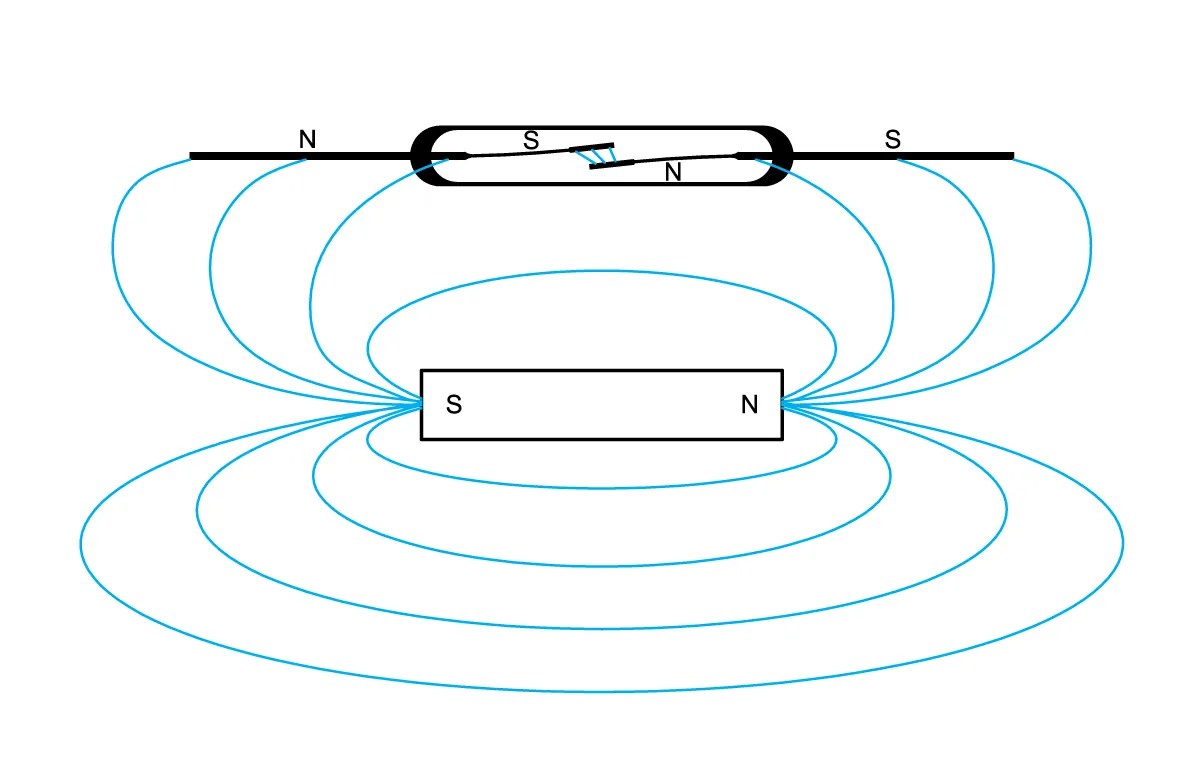
“Magnet interaction effects on reed switch operation can be understood by looking at the magnetic lines of flux and the way the magnet works.”
If there are particular areas you need help with, feel free to skip to any of the following sections:
- Introduction
- Magnet Interaction Effects
- Magnetic Lines of Flux
- How the Magnet Works
- How a Reed Switch Operates Using a Magnet
- Conclusion
- Additional Resources
Introduction
A reed switch is an electromagnetic switching device. Two ferromagnetic blades are housed in a hermetically sealed glass envelope. It has a very simple overall structure and a temperature coefficient of expansion of glass that exactly matches NiFe reeds. Reed switch operation happens when it is brought into proximity to a permanent magnet. The attractive pole of the magnet magnetises the reed contacts.
Magnet Interaction Effects
First, magnet interaction affects the reed switch when a permanent magnet (as shown below) is brought into close proximity to the switch. What happens is the individual reeds become magnetised with the attractive magnetic polarity as shown. Second, the external magnetic field’s strength, or magnetic force of attraction, causes the reed contacts to close. Finally, any residual magnetism on the reed blades would affect the opening and closing behaviour. Therefore, the reed blades are annealed and processed to remove any magnetic retention.
Magnetic Lines of Flux
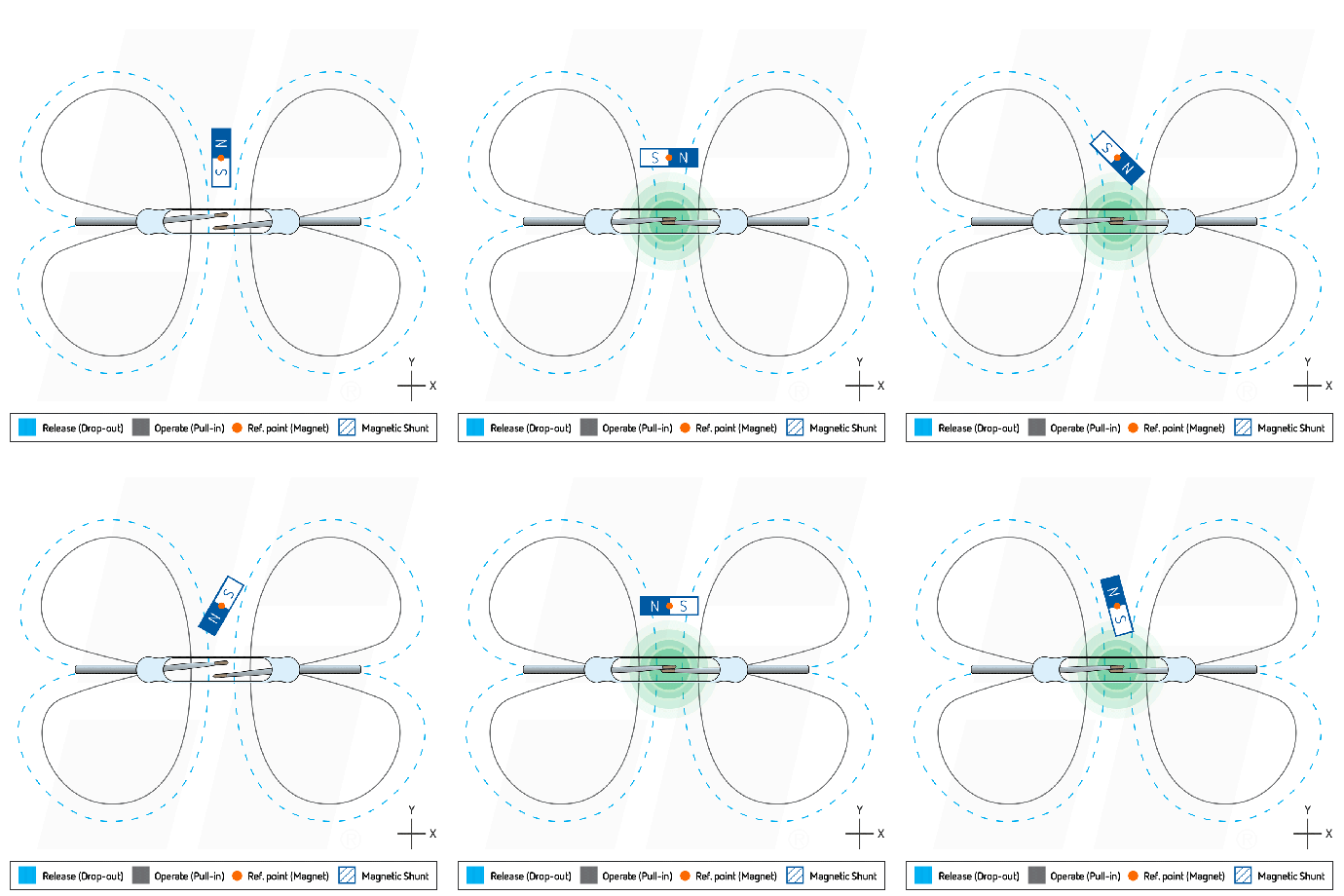
The magnetic lines of flux are the invisible energy forces created by the magnet that act to open and close the switch contacts. Once the magnet crosses the pull-in lines, the contacts close. As long as the magnet stays within the pull-in boundary, the contacts will remain closed. Similarly, when the magnet crosses the drop-out lines, the contacts will open.
How the Magnet Works
A magnet interaction affects the reed switch contacts in a few different ways. The first way is to position the magnet perpendicular to the reed switch, then move the magnet downwards and back up so it travels through the lines of flux. Consequently, the contacts will open and then close again. The next way of making the contacts react is by having the magnet parallel to the reed switch and moving it up and down or side to side, depending on where it is parallel to the reed switch. In other words, moving the magnet up and down parallel to the switch will open and close the contacts. Likewise, moving the magnet side to side on either side of the switch will also cause the contacts to open and close. The last way the magnet works is by rotating it 90 degrees and centring it over the centre lobe of the reed switch. Many applications use this approach to count rotations of mechanisms, which in turn translate the rotations into specific functions.
How a Reed Switch Operates Using a Magnet
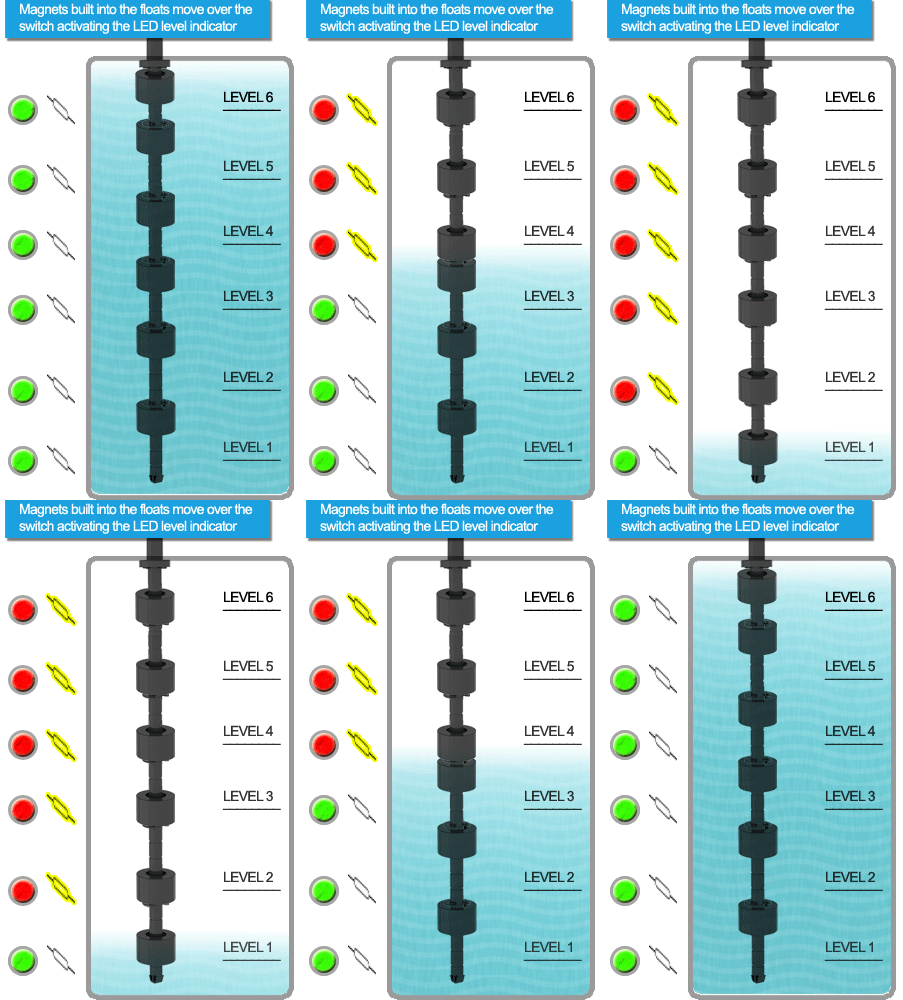
Reed sensors control on and off functions using a reed switch and a magnet. Examples of reed sensor applications range from control circuits, and fluid-level monitoring and detection in coffee pots, to car parts. Without the magnet, reed switches would not operate, and without a moving mechanism to attach to, the magnet would not move through the reed switch’s sphere of influence. This is what causes the magnetic flux to interact with the sensitivity lobe arrays, which then creates the switching function.
Conclusion
Reed switch sensor applications are increasing every day. Knowing the details behind how they work can offer a lot of insight into their proper operation. Understanding how they influence each other is key to a successful reed sensor application. The Standex team is standing by to meet the ever-changing needs of customers across industries and across the world, through our Partner, Solve, Deliver® approach. Get in touch with our team to learn more about our carefully engineered solutions.
Additional Resources
For a deeper understanding of how a reed switch works, download our Reed Technology Databook.
Related Articles
-

Core Sensing Technologies Driving Industry 4.0 Warehousing: An Engineer’s Technical Guide
Industry 4.0 warehouses rely on robust sensing technologies that ensure precise, real-time control of AGVs, AMRs, conveyors, and robotic systems. Reed switches, Hall Effect sensors, and gear tooth sensors provide reliable detection, motion feedback, and rotational data even in harsh industrial environments. Supporting components like reed relays and optocouplers maintain clean, isolated signal paths across…
-

The Unseen Strength: High-Voltage Reed Relays for Cable Testers
High‑voltage testing demands components that ensure safety, reliability and long‑term performance. Reed relays are engineered for these conditions, delivering high isolation voltage, exceptional insulation resistance, low ON resistance and low capacitance. Their ability to switch everything from micro‑level signals to high‑power loads enables precise measurements across vast high‑voltage test systems.
-

Silent Protectors: Monitoring Critical Insulation Measurements in Medical and Energy Systems
Reed relays play a crucial role in maintaining safe, reliable insulation within high‑voltage medical and energy storage systems, where precision and protection are essential. Their high breakdown voltage, exceptional isolation, and low leakage current make them ideal for monitoring dielectric strength and preventing hazardous system failures. As voltages rise in technologies like advanced medical devices…
-

RF Reed Relays for SoC Testers
As today’s SoC devices push further into multi‑GHz RF, multi‑Gbps digital, and precision analog domains, the pressure on test systems to deliver clean, repeatable measurements has never been greater. At the heart of this performance is reliable signal switching and that’s where RF reed relays stand apart.
-
Enabling Safe and Efficient High-Voltage Electrical Systems: High-Voltage Reed Relays in Pre-charge Circuits
Pre-charge circuits prevent damaging inrush currents during start-up in EVs and energy storage systems. Reed relays make these circuits faster, safer, and more reliable with high-voltage tolerance, compact design, and long life, ideal for modern electrification.